
A Response To Joe Rogan’s Rant On Chiropractic.
If you’re a fan of the Joe Rogan Experience, which has grown to become one of, if not the, world’s most popular podcasts since it launched in 2009, you probably caught his less-than-glowing, expletive-filled rant about chiropractic. A reality TV host, UFC commentator, and conspiracy theorist, Joe’s shown himself to be a genuine, open-minded guy that’ll listen to both sides. Personally, I usually love his podcasts. So what happened?
Well, Rogan had a negative experience with a chiropractor, probably not unlike many of my patients at Ascent Chiropractic who’d had bad experiences with other chiropractors before finally finding us, and he felt misled and duped. Naturally, he was upset about it and went looking for confirmation that chiropractic is “BS”.
‘Chiropractors are Bullsh*t’
He found it in an article titled ‘Chiropractors are Bullsh*t’ by a blogger called the SciBabe and blindly repeated what he’d read on his podcast, even featuring the author of said article as a guest. The SciBabe is Yvette d’Entremont, a self-proclaimed skeptic ‘science’ blogger. Now its no secret that few topics in the world of healthcare elicit such passionate responses as chiropractic. I would know, I’ve been in private practice for almost a decade and have heard it all.
To some, we’re life-changing miracle workers. Quoting one of my patients recently, we’re “literally the only office I can walk into hurting so bad that I can’t even stand up straight and walk out like nothing was ever wrong”. To others who’ve never taken the time to look at the evidence, we’re alternative healthcare quacks and any improvements patients get from chiropractic care can be dismissed as 100% placebo. If you’re one of the 35 million Americans who swears by chiropractic or an unemployed former chemistry professor who writes edgy blog posts all day, chances are you probably already have an opinion about my profession.
Now it’s not fair for me to comment on Joe’s case specifically because I’ve never seen his medical records. But writing off an entire profession after having one bad personal experience? I suppose billion dollar organizations like Google and nearly every major sports team including the Super Bowl Champion New England Patriots have no clue what they’re investing in, right?
What Joe Rogan & Yvette d’Entremont Got Right
While most of the podcast was totally misinformed on the facts and skewed by clear confirmation bias, Rogan and the SciBabe had some fair points. The chiropractic profession has its problems, and blindly defending it minimizes legitimate concerns. There are too many chiropractors prescribing one-size-fits-all treatment plans, claiming they can treat conditions outside our scope of practice, failing to base their patient care on the best-available evidence, and adhering to unscientific metaphysical/magical concepts of health. But they’re a vocal minority, and they definitely don’t represent the entire profession.
There’s no doubt that there are bad chiropractors out there, but the same can be said for medicine, law, tax accounting and just about every other professional service.
What They Got Wrong
Let’s dismantle the SciBabe’s claims one by one. Warning: this is a long one, because she’s wrong about a lot.
Chiropractic is little more than the buffoonery of a 19th-century lunatic.
The truth: As a profession, there’s been a fair share of discord in chiropractic’s history. The first ‘chiropractic’ adjustment was performed in 1895 by a ‘magnetic healer’ named DD Palmer whose janitor had injured his neck and lost his hearing. Palmer ‘adjusted’ him and his hearing was restored.
Before we go further, let’s take into account what the state of medicine and knowledge of the human body was like in the late 1800’s. It would be more than fifty years before procedures like lobotomies and drugs like thalidomide were eliminated from mainstream medicine. Diarrhea and the flu were the most common causes of death. Smoking was good for you. Bloodletting was still a thing. Average life expectancy was under 50 years.
So in an effort to explain what he’d just seen happen with his ‘adjustment’, he (along with his son BJ) developed a slightly wacky metaphysical theory that there was a life force flowing from the brain through the spinal cord and out to the parts of the body, and when a vertebra shifted out of place (a ‘subluxation’) this ‘life force’ was cut off, leading to dysfunction and disease. While this explanation was much more ‘woo-y’ than we’d likely accept today, the fact is that the earliest chiropractors were getting results with patients, even if they didn’t have a scientifically sound explanation for why.
It’s not the first time it’s happened in the history of healthcare. Take aspirin, literally the most widely used medicine of all time. Though it was first introduced in 1897, doctors had no idea how it worked until almost a century later, after prescribing it to billions of patients. Scientists initially thought it worked by affecting the central nervous system (totally wrong) until 1971 (when we discovered that it’s actually through inhibition of prostaglandin production).
In any case the argument is irrelevant, because within a decade the first chiropractic textbook had been published, ‘Modern Chiropractic’, defining a subluxation as an aberrant motion of the spine and the role of chiropractic to restore that motion and moving away from the theories Yvette claims “every chiropractor adheres to”.
Today the World Health Organization defines the term subluxation as “a lesion or dysfunction in a joint or motion segment in which alignment, movement integrity and/or physiological function are altered, although contact between joint surfaces remains intact. It is essentially a functional entity, which may influence biomechanical and neural integrity.” This is our understanding of the concept of subluxation today and most chiropractors treat their patients with the end goal of restoring motion to segments of the spine that are moving abnormally, using chiropractic adjustments along with modern soft tissue techniques like Active Release Therapy, kinesiotaping and active rehabilitative exercise.
“There is scant medical evidence that a chiropractor is your best treatment option for… anything”
Oh really? Let’s take just low back pain and see what the evidence is for chiropractic intervention.
The American College of Physicians (ACP), the world’s largest medical society, thought quite differently when they updated their low-back pain treatment guidelines last year. Published in the Annals of Internal Medicine and based on a huge review of randomized controlled trials and observational studies, the 2017 ACP guidelines cite chiropractic care as one of the best options for non-invasive, non-drug treatment for low back pain. The guidelines state that ‘only when such treatments provide little or no relief should patients move on to medicines such as ibuprofen or muscle relaxants, which research indicates have limited pain-relief effects‘.
A large-scale double-blind study on the effectiveness of chiropractic care for acute low back pain, authored by medical doctors and published in the prestigious medical journal Spine concluded: “This is the first time that spinal manipulation was investigated in a double-blinded randomized controlled design showing clear superiority compared with placebo and NSAID. High velocity, low amplitude (HVLA) manipulation can be recommended for the therapy of acute nonspecific low back pain. Final evaluation showed manipulation being significantly better than NSAID and clinically superior to placebo.”
Spine also recently published a study investigating the effectiveness of adding chiropractic care to standard medical care for acute low back pain. They found that “73% of participants in the standard medical care plus chiropractic group rated their overall improvement as pain completely gone, much better, or moderately better, compared with 17% in the group receiving only standard medical care.” That means they found that chiropractic care along with medical care was more than 4x more effective than just medical care.
Another recent study published in Spine even touts the benefits of maintenance chiropractic care, stating: “This study confirms previous reports showing the chiropractic care is an effective modality in chronic nonspecific low back pain especially for short term effects. As patients did benefit from the maintenance treatments, we believe that periodic patient visits permit proper evaluation, detection, and early treatment of an emerging problem, thus preventing future episodes of low back pain.”
There are hundreds of available studies showing chiropractic is far and away the most effective treatment for low back pain. A humble suggestion for the SciBabe? For someone that claims to worship at the altar of peer-reviewed evidence, it’d be worthwhile learning how to do a simple PubMed search before making misinformed claims like the one above.
“The medical community disavows chiropractic”
If that’s the case then someone needs to alert the National Institutes of Health, the National Institute of Health and Care Excellence (NICE), Towards Optimized Practice (TOP) (source page unavailable), the Journal of Orthopedic and Sports Physical Therapy (JOSPT), the American College of Physicians (ACP), and Harvard Medical School to revise their clinical guidelines, because they all recommend chiropractic care as a first-line treatment option for back pain.
The truth is, I work with medical doctors, osteopaths, doctors of physical therapy and orthopedic surgeons nearly every day in the co-management of my patients. They love what I do because it gets long-term results, reduces reliance on medication, and saves patients from requiring surgery. On the other hand, there are a huge number of conditions that are totally out of my scope of practice that I need to refer to them to treat. It’s a win-win situation, and we’re only going to become more integrated as time goes on.
“Chiropractic is dangerously far removed from mainstream medicine, and the vocation’s practices have been linked to strokes, herniated discs, and even death.”
Yvette makes this claim without any context; but guess what else is associated with those risks? Exercise and medicine.
As with every health care treatment, there are some risks associated with chiropractic manipulation. The one that Yvette chooses to run with is the idea that cervical manipulation can cause injury to the arteries that run through the neck and possibly lead to stroke. Over the years, reports in the popular press have suggested or stated outright that in patients who experience a stroke following chiropractic care, the stroke was caused by the chiropractor. But if that was the case, how has our profession survived this long?
And more importantly, why are our malpractice insurance premiums so low? Rates for the highest coverage available are typically under $2,000 per year. Contrast that to malpractice rates for medical doctors that can be 10 to 100 times that amount. The answer: because the risk of injury resulting from chiropractic is ridiculously low. The best available estimates place the likelihood of complications following a spinal manipulation at 1 in 3,000,000.
But even then, correlation doesn’t mean causation. A 2008 study from the European Spine Journal showed that the rate of stroke following a chiropractic appointment was no different than the rate of stroke following a visit to a family physician. What is far more likely is that the patient developed a thrombus or embolism in their vertebral arteries that resulted in neck pain and headaches, leading them to seek out help for the pain. Whether they saw a chiropractor or their medical provider, they would progress on to a stroke at virtually the same rate. While the argument that the chiropractor caused the problem is convenient, the evidence indicates that in all likelihood that conclusion is totally wrong.
A 2016 review and meta-analysis of chiropractic care and stroke by a team of medical doctors from the Penn State Department of Neurology also concluded that “there is no convincing evidence to support a causal link between chiropractic manipulation and cervical artery dissection.”
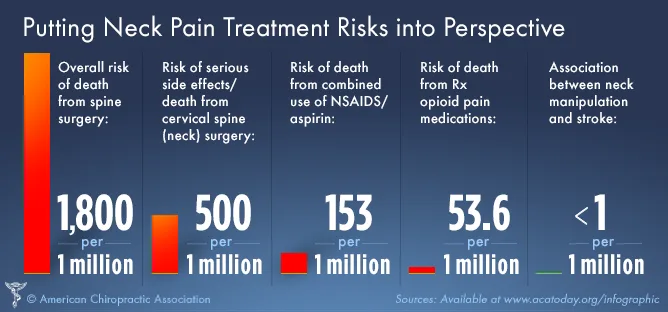
Now compare that to the risk of death from gastrointestinal bleeding after taking NSAIDs/aspirin, which is estimated to be 1 in 6,500 individuals, or any of the other interventions in the infographic below, and the choice between seeing a chiropractor to fix the problem or continuing to pop meds to hide the symptoms suddenly becomes easy.
Chiropractic Evidence: Key Takeaways
The bottom line is that the breadth and depth of research establishing the safety and effectiveness of chiropractic care, especially when compared to the alternatives, has never been better than it is today. And you know who benefits the most? The patients who get better with chiropractic care after everything else has failed them. One can only hope that as ‘skeptics’ start actually paying attention to what the evidence is saying, more people will find the help they need.
Personalized Chiropractic Care in Brookfield
At Ascent Chiropractic we’re committed to not just relieving symptoms but to correcting their cause and optimizing your body to function better than it ever has before. Our unique, low-force, evidence-based approach to chiropractic care combined with the best of physical rehabilitation therapies allows us to get unmatched, long-term results. Discover the difference personalized, comprehensive care at Ascent Chiropractic makes. Instead of just fixing your pain, let’s fix you. To schedule an appointment, call us at 262-345-4166 or use our online scheduling app.